





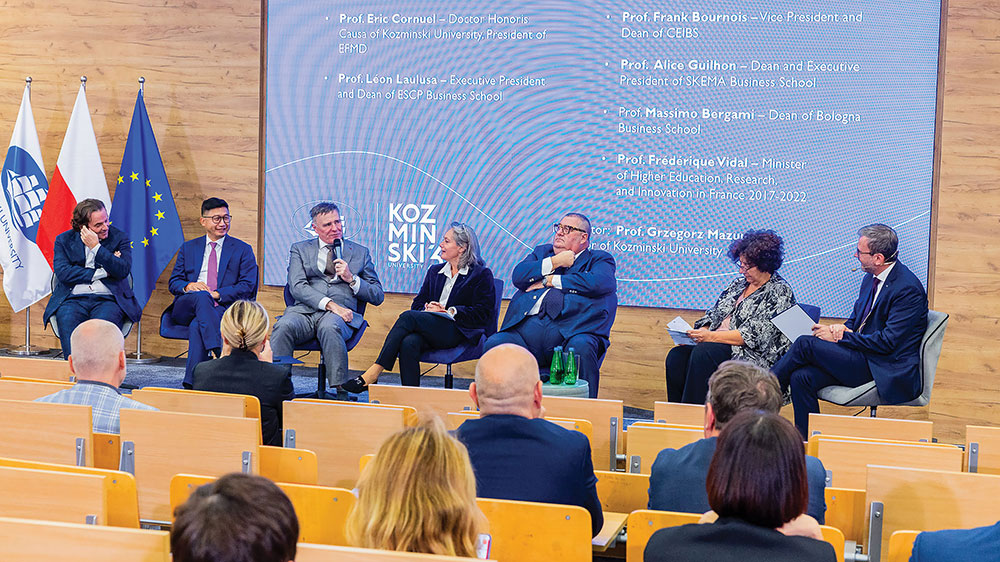
What should modern business schools be like and what challenges of the future should they respond to? This is the voice of representatives of leading European business schools, participants in a debate held at Kozminski University.
Professor Grzegorz Mazurek, rector of ALK, who moderated the discussion, formulated two fundamental problems: what is the world that surrounds us today and what megatrends will characterize it in the near future, and what should the new business schools working for this new world look like?
The debate under the theme A New School for a New World was attended by:
- Prof. Eric Cornuel - President EFMD
- Prof. Léon Laulusa - Executive President and Dean ESCP Business School
- Prof. Frank Bournois - Vice President and Dean CEIBS
- Prof. Massimo Bergami - Dean of Bologna Business School
- Prof. Alice Guilhon - Executive President and Dean SKEMA Business School
- Prof. Frédérique Vidal - Minister of Higher Education, Research and Innovation in France from 2017 to 2022.
The discussion revolved around several important issues, a selection of which are presented below.
New technologies
Massimo Bergami, in a reference to the technological revolution, intimated that the development of artificial intelligence cannot be stopped, as its role is already gigantic and continues to grow. - We need to be smarter than artificial intelligence," postulated Léon Laulusa, while Eric Cornuel, who agreed that AI will change the existing education system, immediately gave a concrete example of the use of AI in education: - I envision a common repository of knowledge resources from all business schools available to all.
New competencies for graduates
Frank Bournois pointed out that today everyone wants to learn new skills quickly, which shortens the education cycle. This means constantly changing programs so that we no longer teach any skills that are considered obsolete. - We have to be vigilant not to teach students what we should no longer teach, and in fact we have to teach them what we taught before," he said. In the context of the new competencies needed, the topic of interdisciplinarity was emphasized: - Business leaders must have a broader view of the world, they cannot focus only on techniques taught in business schools, Massimo Bergami said.
Eric Cornuel noted that today's widespread trend of lifelong learning means not only retraining and improving competencies, but also strengthening the relationship between graduates and the university. A new role is emerging here for professors, who can be mentors, support graduates in their career development, and pass on the ability to acquire knowledge.
A new vision for the university
All participants in the debate were critical of teaching only management support tools in business schools.
Frédérique Vidal stressed the importance of interdisciplinarity and truly supporting values. - Many countries and societies do not share our values, she said. - Europeans, Indians, Chinese and Africans are very different, and this must be taken into account in international academia.
Massimo Bergami agreed that in academia it is necessary to talk about values first and foremost: - To catch what is important to young people, and to include it in the curricula. He also gave examples of multidisciplinarity, including from his university: schools of law, industrial design, geopolitics and even fashion are being created around the business school, all in an effort to make the student's education cross-cutting, so that graduates have a holistic view of business, society and politics. Bergami said: - The academic community, professors and students, must share a passion for learning about the world and exchanging knowledge, and when they are locked in their own silos, they will not develop this openness.
The greater use of interdisciplinary resources was also alluded to by Eric Cornuel, who reminded us that knowledge locked away in the strongholds of disciplines does not drive social development the way its exchange through interdisciplinary networks does: - All knowledge should be shared, and collaboration should be rewarded.
Léon Laulusa said that multidisciplinarity today is part of the idea of lifelong learning. - Today, everyone is a lifelong student. Three years ago at ESCP BS we implemented digital competency passports, which increases the employability of graduates. We need to listen to the voices coming from companies as to whether they are satisfied with the kind of graduate we are churning out.
Can such graduates change the world?
Cooperation with the environment
Eric Cornuel reminded the audience of the importance of the business school's relationship with business practice, and pointed out that the university can become a safe place in which to develop a
mechanisms for cooperation with the political and economic community. - Universities and professors can play a new role in the economic ecosystem, connecting business and society. For many business schools, standing at the forefront of these changes is undoubtedly difficult, as it requires the courage to reconcile stakeholders with different goals and break through the resistance of supporters of the old paradigm, he said.
Frank Bournois joined this voice, stressing that lecturers, who are the university's most valuable asset, need to be better connected to the real world, especially the new world that is emerging. The best way to do this is to sit on corporate boards or even participate in business management. There are universities where this is avoided in order to preserve the independence of scholars, but this is not good for students. They expect their lecturers not just to be theoreticians, but to be in touch with practice.
Alliance of universities
Alice Guilhon recognized the need for consistency in the organization of business schools: - We cannot act in isolation without looking at others. We need mechanisms for collective action. We could share courses and teaching content with each other, which would certainly improve young people's understanding of the new world. We should build networks.
The topic of business university cooperation was picked up by other participants in the debate. Eric Cornuel stated: - We don't need a thousand different accounting courses in a thousand business schools, but we do need graduates who can think critically about the impact of business and market actions on trust in democratic institutions. We have valuable resources, why don't we share them? We are not Coca-Cola, we are not fighting over stock prices. Business schools could share an accounting course, offer an online program with self-assessment of progress to gain time to solve unique cases in a smaller group classroom, to analyze interesting elements of balance sheets and income statements. In this way, we would regain resources for more interesting things.
Massimo Bergami lamented that European business schools are lagging behind compared to China, for example. - We can quickly close the gap by implementing technologies used in industry. Why can't we use artificial intelligence in education? - he asked. And he stressed that the cooperation of good business schools and the use of artificial intelligence in mass didactics are already a necessity.
Agility
Frank Bournois recognized that business management today requires, above all, agility, because it is not at all the strongest who survive, but those who adapt best to changing conditions. Hence, the most important thing for new business schools will be the ability to anticipate what might happen, catch weak signals and adjust their strategies accordingly. He noted that business schools themselves have not always been well managed, and the new times require them to work as nimbly as businesses.
Grzegorz Mazurek, who moderated the debate, pointed out that ossified regulations and overly formal accreditation procedures could prove to be a brake on this path.
Eric Cornuel said that EFMD, as an accrediting body, changes expectations of top universities on an ongoing basis according to rules that the universities themselves set. Accreditors merely follow them: - Agility is one of our obsessions. At EFMD we are afraid of the word standard, we don't set any standards ourselves, because it is the schools that shape new standards, and we only measure them. That's why accreditation itself appears as such a moving target.
Sensitivity
An interesting thread in the debate was initiated by Alice Guilhon, who pointed to the soft elements of business school education that stimulate students' sensitivity, but also their resilience to failure. - A good measure of our success would be if students were able to approach again what they have already failed at once. Europe needs the culture of good failure that America has.
Léon Laulusa affirmed that ESCP BS strives to provide education in three dimensions: values, mission driven by purpose (a better society living in peace) and happiness. - Students must be happy in the real world, not in the virtual world. There is no pain and sadness there, but there is also no real interaction. Values must relate to the real world and correspond to what is important to society.
Ewa Barlik
published: November 1, 2023